Showing posts with label eid. Show all posts

Friday, October 26, 2012

Islamic method of Slaughtering


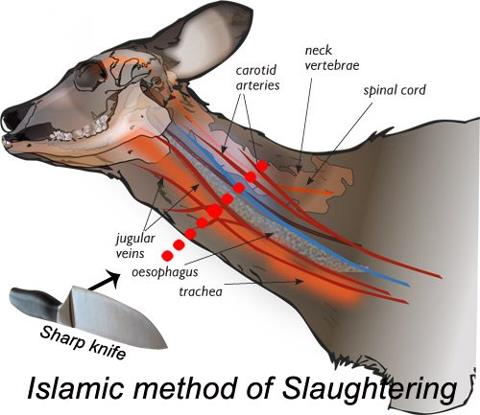
The Islamic method of slaughtering animals, known as Zabiha has been the object of much criticism from a large number of people.

One may consider the following points, which prove that the Zabiha method is not only humane but also scientifically the best:

1.) Islamic method of slaughtering animal
Zakkaytum is a verb derived from the root word Zakah (to purify). Its infinitive is Tazkiyah which means purification. The Islamic mode of slaughtering an animal requires the following conditions to be met:

a.) Animal should be slaughtered with sharp object (knife)
The animal has to be slaughtered with a sharp object (knife) and in a fast way so that the pain of slaughter is minimised.

b.) Cut wind pipe, throat and vessels of neck
Zabiha is an Arabic word which means ‘slaughtered’. The ‘slaughtering’ is to be done by cutting the throat, windpipe and the blood vessels in the neck causing the animal’s death without cutting the spinal cord.

c.) Blood should be drained

The blood has to be drained completely before the head is removed. The purpose is to drain out most of the blood which would serve as a good culture medium for micro organisms. The spinal cord must not be cut because the nerve fibres to the heart could be damaged during the process causing cardiac arrest, stagnating the blood in the blood vessels.

2.) Blood is a good medium for germs and bacteria
Blood is a good media of germs, bacteria, toxins, etc. Therefore the Muslim way of slaughtering is more hygienic as most of the blood containing germs, bacteria, toxins, etc. that are the cause of several diseases are eliminated.

3.) Meat remains fresh for a longer time Meat slaughtered by Islamic way remains fresh for a longer time due to deficiency of blood in the meat as compared to other methods of slaughtering.

4.) Animal does not feel pain
The swift cutting of vessels of the neck disconnects the flow of blood to the nerve of the brain responsible for pain. Thus the animal does not feel pain. While dying, the animal struggles, writhers, shakes and kicks, not due to pain, but due to the contraction and relaxation of the muscles defecient in blood and due to the flow of blood out of the body.


A must watch: http://www.youtube.com/watch?v=d_olDAtxyTw
 

Monday, August 20, 2012

The Eid of our Pious Predecessors


Eid-ul-Fitr is not all about dressing up in fine new clothes, eating delicious treats and pursuing carnal pleasures and delights.

In its outward celebration Eid-ul-Fitr is actually meant to symbolize:
  • the acceptance of acts of worshipful obedience;
  • the remission of sins and mistakes;
  • the conversion of bad deeds into good deeds;
  • the glad tidings of promotion to higher spiritual degrees
  • and the conferring of robes of honor, gifts and gracious favors.

Eid should be celebrated, but together with celebrating it, Allah Ta’ala should also be remembered.
Whether there is happiness or sadness, He should never be forgotten; just as Rasoolullah (Sallallahu Alaihi Wasallam) has said, “The people who will be called towards Paradise first on the Day of Judgment are those who praised Allah Ta’ala during happiness and sadness.”

 Let us look at the true essence and significance of Eid-ul-Fitr and the way in which those pious servants closest to Almighty Allah celebrated Eid.

Eid of our Pious Predecessors 
If we study the lives of the Companions and our pious predecessors we will see that even though they used to worship extensively in the month of Ramadaan, they would still feel regret and sorrow on the day of Eid. They were constantly worried about the fact of whether or not they had fulfilled the rights of Ramadaan.

Sayidinna Umar RA
It is reported about Hazrat Umar (Radiallahu Ta’ala Anh) that on the day of Eid, he sat in a corner and cried so much that his blessed beard became soaked. When people asked the reason for this, he replied, “How can a person who does not know if his fasts have been accepted celebrate Eid?”  

This is that same Hazrat Umar (Radiallahu Ta’ala ‘Anh) about whom Rasoolullah (Sallallahu Alaihi Wasallam) said that his good deeds are equivalent to the number of stars in the sky, is crying upon reflecting as to whether his fasts have been accepted or not, whether he has obeyed the orders of Almighty Allah properly and if Allah Ta’ala is pleased with them.
Allahu Akbar Kabeera!
And yet sinners like us are absolutely carefree and cannot wait to engage ourselves into sin again!

Sayidinna Ali RA
It was on the day of Eid-ul-Fitr that a man once entered the presence of Hadrat Ali (Radiallahu Ta’ala Anh) and found him eating coarse brown bread.
“Today is the day of Eid, yet here you are, eating coarse brown bread!” the man exclaimed.
So Hadrat Ali (Radiallahu Ta’ala Anh) replied to the visitor, saying, “Today is the day of Eid for someone whose fast has been accepted, whose effort has been deemed worthy, and whose sin has been forgiven. Today is Eid for us, and tomorrow is Eid for us. Every day in which we do not disobey Allah Ta’ala is an Eid for us.”

Commenting on this incident,  Hazrat Shaykh Sayyid Abdul Qadir Jilani (R.A.) says that it is therefore important for every intelligent person to stop focusing on the external aspect, and not to let it capture his attention. His perspective on the day of Eid should be from the standpoint of contemplation and reflection.

Let us, this year spend a different Eid than we have spent all our lives, and show some loyalty to our Rabb who gave us the blessing of Ramadan. Let us prove to Him that we worship not only the Rabb of Ramadan but the Rabb of all 12 months. And that we want to please Him outside of Ramadan as well!

Source: https://www.facebook.com/notes/zaynab-academy-karachi-unofficial/the-eid-of-our-pious-predecessors/233043146819067

Monday, November 7, 2011

How to Spend your 'Eid' according to Sunnah


“Praise be to Allah (s.w.t) The most Merciful The most Beneficent”
Some of the Sunnah’s that should be observed on the day of Eid are mentioned below:


Doing Ghusl Before Going Out for The Eid Prayer:
It was narrated in a saheeh hadeeth in al-Muwatta’ and elsewhere that ‘Abd-Allaah ibn ‘Umar used to do ghusl on the day of al-Fitr before going out to the prayer-place in the morning. Al-Muwatta’ 428. 
Al- Nawawi (may Allaah have mercy on him) said that the Muslims were unanimously agreed that it is mustahabb to do ghusl for Eid prayer. 
The reason why it is mustahabb is the same reason as that for doing ghusl before Jumu’ah and other public gatherings. Rather on Eid the reason is even stronger.

Eating before going out to pray on Eid al-Fitr and after the prayer on Eid al-Adha:
Part of the etiquette is not to go out to pray on Eid al-Fitr until one has eaten some dates, because of the hadeeth narrated by al-Bukhaari from Anas ibn Maalik, who said that the Messenger of Allaah (peace and blessings of Allaah be upon him) used not to go out on the morning of Eid al-Fitr until he had eaten some dates of which he would eat an odd number. Al-Bukhaari, 953. 
It is mustahabb to eat before going out to emphasize the fact that it is forbidden to fast on that day and to demonstrate that the fast has ended. 


Takbeer on the day of Eid:
This is one of the greatest Sunnahs on the day of Eid because Allaah says (interpretation of the meaning): 


“(He wants that you) must complete the same number (of days), and that you must magnify Allaah [i.e. to say Takbeer (Allaahu Akbar: Allaah is the Most Great)] for having guided you so that you may be grateful to Him”
[al-Baqarah 2:185] 


It was narrated that al-Waleed ibn Muslim said: I asked al-Awzaa’i and Maalik ibn Anas about saying Takbeer out loud on the two Eids. They said, Yes, ‘Abd-Allaah ibn ‘Umar used to say it out loud on the day of al-Fitr until the imam came out (to lead the prayers). 

Offering Congratulations:
It was narrated that Jubayr ibn Nufayr said: When the companions of the Prophet (peace and blessings of Allaah be upon him) met one another on the day of Eid, they would say to one another, “May Allaah accept (good deeds) from us and from you.” Ibn Hajar said, its isnaad is hasan. Al-Fath, 2/446. 

Part of the etiquette is not to go out to pray on Eid al-Fitr until one has eaten some dates, because of the hadeeth narrated by al-Bukhaari from Anas ibn Maalik, who said that the Messenger of Allaah (peace and blessings of Allaah be upon him) used not to go out on the morning of Eid al-Fitr until he had eaten some dates… of which he would eat an odd number. Al-Bukhaari, 953. 
It is mustahabb to eat before going out to emphasize the fact that it is forbidden to fast on that day and to demonstrate that the fast has ended. 


Adorning oneself on the occasion of Eid:
It was narrated that ‘Abd-Allaah ibn ‘Umar (may Allah be pleased with him) said that:
“Umar took a brocade cloak that was for sale in the market and brought it to the Messenger of Allah (peace and blessings of Allah be upon him), and said, “O Messenger of Allah, buy this and adorn yourself with it for Eid and for receiving the delegations.” The Messenger of Allah (peace and blessings of Allah be upon him) said to him, “Rather this is the dress of one who has no share (of piety or of reward in the Hereafter)” [Narrated by al-Bukhaari, 948.
]


The Prophet (peace and blessings of Allaah be upon him) agreed with ‘Umar on the idea of adorning oneself for Eid, but he denounced him for choosing this cloak because it was made of silk. 


It was narrated that Jaabir (may Allaah be pleased with him) said: The Prophet (peace and blessings of Allaah be upon him) had a cloak which he would wear on the two Eids and on Fridays. Saheeh Ibn Khuzaymah, 1756, 

Al-Bayhaqi narrated with a saheeh isnaad that Ibn ‘Umar used to wear his best clothes on Eid. 
So a man should wear the best clothes that he has when going out for Eid. 

With regard to women, they should avoid adorning themselves when they go out for Eid, because they are forbidden to show off their adornments to non-mahram men. It is also haraam for a woman who wants to go out to put on perfume or to expose men to temptation, because they are only going out for the purpose of worship. 

 
Our Prophet Muhammad (pbuh) reported that servants who get cleaned by fasting and worshiping should wish whatever they want from Allah.

“In the morning eids, when muslims congregated in mosques for prayer, Allah (swt) asks angels, “What is the reward of a person who completes his duty?”

Angels say: “It is to collect his/her payment.”

Then Allah (swt) says: “Witness that I place my consent and forgiveness on my servants who fasts (sawm) and prays in Ramadan. O My servants, today wish whatever you want from me because I will give whatever you want for the right to my glory and Jalal.” (Bayhaki)

Rejoice on the Eid day
When the day of Ramadan eid comes (Eid-ul-Fitr) angels stand on roads and say:

"O Muslim Community! Please run towards your generous Lord, he does favours and bestows generously. You've been ordered to pray at nights, to fast (sawm) in the daytime. Fast and you obey your Lord so you can get your rewards.”


When they pray, a voice speaks: "Listen well, your Lord has forgiven you. Return to your homes having found the right path. The day of eid is the day of reward. Today is called "reward day" on the heaven." (Tabarani)


Go out on the day of eid:

Our Prophet Muhammad (pbuh) narrated that Allah would manifest himself on the earth in feast day with his own mercy.

“Allah manifests himself with His mercy on the earth on the days of eid of Ramadan (Al-Fitr) and Sacrifice (Al-Adha). If so, you should go out of the house for visiting and salah so that mercy can touch you." (Ibn-i Asakir)