Showing posts with label islamic. Show all posts

Tuesday, December 25, 2012

Life of Imam Bukhari


Muhammad Ibn Ismail Ibn Ibrahim Ibn al-Mughirah Ibn Bardizbah al-Bukhari popularly known as Bukhari or Imam Bukhari, was a Sunni Islamic scholar of Persia. He is the author of the collection of Hadiths which Sunni Muslims regard as the most authentic of all Hadith compilations, the Sahih Al-Bukhari. Most Sunni scholars consider it second only to the Qur’an in terms of authenticity. The Arabic word sahih translates as authentic or correct. Imam Bukhari was born in 810 A.D. / 196 A.H. in Bukhara, Uzbekistan. His father, Ismail Ibn Ibrahim, was a known hadith scholar who died while he was still an infant and he was hence raised by his mother. Imam Bukhari began studying hadith, memorising works of Abdullah ibn al-Mubaarak while still a child. At age of sixteen, Imam Bukhari made the pilgrimage to Mecca, beginning a series of travels in order to increase his knowledge of hadith. He went through all the important centres of Islamic learning of his time, talked to scholars and exchanged information on hadith. It is said that he heard from over 1,000 men, and learned over 600,000 traditions. After sixteen years’ absence he returned to Bukhara, and drew up his al-Jami’ as-Sahih, a collection of 7,275 tested traditions, arranged in chapters so as to afford bases for a complete system of jurisprudence. Imam Bukhari finished his work around 846 A.D., and spent the last twenty-four years of his life visiting other cities and scholars, teaching the hadith he had collected. In every city that he visited, thousands of people would gatherin the main mosque to listen to him recite traditions. Imam Bukhari died in a village near Samarkand in the year 870/256.

The Sahih Al-Bukhari book covers almost all aspects of life in providing proper guidance of Islam such as the method of performing prayers and other actions of worship directly from Prophet Muhammad (peace be upon him).

Hadiths are a practical example of the implementation of Quranic guidance and are essential supplements to the teachings of the Quran. Neither the Quran nor the Sunnah can be understood correctly without the other. They have been meticulously compiled by individuals with exceptional memory skills and analytical expertise like Imam Bukhari, who travelled tirelessly to collect thousands of narrations and distinguish the true words of prophetic wisdom. Muslims during the time of Prophet Muhammad (peace be upon him)and generations that followed and generations to come are blessed to have these pearls of wisdom to guide us in a righteous, Islamic way of life leading to Al-Firdaus.

Friday, October 26, 2012

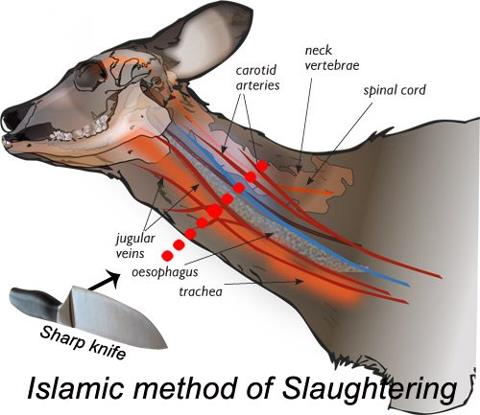
Islamic method of Slaughtering


The Islamic method of slaughtering animals, known as Zabiha has been the object of much criticism from a large number of people.

One may consider the following points, which prove that the Zabiha method is not only humane but also scientifically the best:

1.) Islamic method of slaughtering animal
Zakkaytum is a verb derived from the root word Zakah (to purify). Its infinitive is Tazkiyah which means purification. The Islamic mode of slaughtering an animal requires the following conditions to be met:

a.) Animal should be slaughtered with sharp object (knife)
The animal has to be slaughtered with a sharp object (knife) and in a fast way so that the pain of slaughter is minimised.

b.) Cut wind pipe, throat and vessels of neck
Zabiha is an Arabic word which means ‘slaughtered’. The ‘slaughtering’ is to be done by cutting the throat, windpipe and the blood vessels in the neck causing the animal’s death without cutting the spinal cord.

c.) Blood should be drained

The blood has to be drained completely before the head is removed. The purpose is to drain out most of the blood which would serve as a good culture medium for micro organisms. The spinal cord must not be cut because the nerve fibres to the heart could be damaged during the process causing cardiac arrest, stagnating the blood in the blood vessels.

2.) Blood is a good medium for germs and bacteria
Blood is a good media of germs, bacteria, toxins, etc. Therefore the Muslim way of slaughtering is more hygienic as most of the blood containing germs, bacteria, toxins, etc. that are the cause of several diseases are eliminated.

3.) Meat remains fresh for a longer time Meat slaughtered by Islamic way remains fresh for a longer time due to deficiency of blood in the meat as compared to other methods of slaughtering.

4.) Animal does not feel pain
The swift cutting of vessels of the neck disconnects the flow of blood to the nerve of the brain responsible for pain. Thus the animal does not feel pain. While dying, the animal struggles, writhers, shakes and kicks, not due to pain, but due to the contraction and relaxation of the muscles defecient in blood and due to the flow of blood out of the body.


A must watch: http://www.youtube.com/watch?v=d_olDAtxyTw
 

Wednesday, June 20, 2012

Jazkallahu Khayran OR Jazakallah OR Thankyou OR Shukran? What is the correct Islamic way?


Good manners dictate that you should reciprocate the one who does you a favor in kindness.

Meaning of various words used to reciprocate the one who does you a favour: 

THANK YOU = a polite expression of gratitude=Thanks = 10x= Shukriya= Shukran
JazakAllahu Khair = MAy Allah reward you or grant you with good

Does THANKS give any DUA better or equal to JazakAllahu Khair ? NO !!!!


Reciprocating kindness means choosing that which will make the one who did you a favour feel happy, just as he made you feel happy. So you should strive to thank him in kind.

Allaah says in Quran: “Is there any reward for good other than good?”
[al-Rahmaan 55:60]


"The one who does not give thanks to people does not give thanks to Allah (Subhanahu wa Tala)" - Reported by Bukhari in al-Adab al-Mufrad.

If you are not able to reciprocate with a gift, or helping with some task, or offering some service, etc, then at least you can say du’aa’ for him, and this du’aa’ may be a means of bringing him happiness in this world and in the Hereafter.

One of the best forms of du’aa’ for the one who has done you a favour is that which is mentioned in the Sunnah:
i) The Prophet (peace and blessings of Allaah be upon him) said: “Whoever has a favour done for him and says to the one who did it, ‘Jazak Allaahu khayran,’ has done enough to thank him.”

[Narrated by al-Tirmidhi, 1958 & 2035; Abu Dawood (1672) and by al-Nasaa’i in al-Sunan al-Kubra (6/53); classed as saheeh by al-Albaani in Saheeh al-Tirmidhi.].
This du’aa’ is also narrated from the Prophet (peace and blessings of Allaah be upon him) in a lengthy hadeeth in which it says:

ii) “You are the Ansaar, may Allaah reward you with good (jazaakum Allaahu khayran), for you are decent and patient.”

[Narrated by Ibn Hibbaan (7277) and al-Haakim (4/79). He said: its isnaad is saheeh, and al-Dhahabi agreed with him. Shaykh al-Albaani said in al-Silsilah al-Saheehah (3096): It is as they said].

This phrase was often uttered by the Sahaabah (may Allaah be pleased with them).

iii) ‘Umar ibn al-Khattaab (may Allaah be pleased with him) said: If one of you knew what there is in his saying to his brother, ‘Jazaak Allaahu khayran’, you would say it a great deal to one another [Musannaf Ibn Abi Shaybah (5/322)].

iv) Usayd ibn al-Hudayr (may Allaah be pleased with him) said to ‘Aa’ishah (may Allaah be pleased with her): May Allaah reward you with good (O ‘Aa’ishah), for by Allaah, you never have any problem but Allaah grants you a way out and makes it a blessing for the Muslims. Narrated by al-Bukhaari (336) and Muslim (367).

v) Ibn ‘Umar (may Allaah be pleased with him) said: I came to my father when he was wounded and they praised him and said: May Allaah reward you with good, and he said: I have hope and fear – meaning hope for that which is with Allaah of reward and mercy, and fear of that which is with Him of punishment
[Saheeh Muslim 1823].

Jazakallah or Jazakallah Khair? Understanding Grammar Behind The word Jazakallah:
Jazaak comes from the root word jazaa
which according to the popular Arabic-English dictionary, Al-Mawrid, has two meanings that are completely opposite to eachother!

Thus 'jazaa
' can either mean reward OR punishment.
So: "JazakAllah" can may either mean "may Allah reward you" or punish you, while
"JazakAllah Khair" means ... "may Allah reward you with the Best/Good",

So the correct way is to say Jazakallah khair & not just jazakAllah. Though someone might say that the intention by saying jazakallah is the same like jazakallahu khayran, if its so, then why not use the complete wordings as used by prophet(pbuh) and the sahabas? which is jazakallahu khayran !

Jazak Allahu Khair depending on situation:
Masculine: Jazak Allahu Khair
Feminine:
Jazaki Allahu Khair
Plural: Jazakum Allahu Khair

Substitute for Jazakallah khair is BarakAllah Feek ( "May the blessings of Allah be upon you.")

How to Reply to Those who says Jazakallahu khair to you:
1)
Wa Antum fa Jazakumullahu khayran meaning "And you too, May Allah reward to with Khayr".
Evidence from Sunnah: Usayd ibn Hadayr (sahabi) says: I said:
O Messenger of Allah
جزاك الله خيرا [Jazaakallhu Khayran]
The Prophet(pbuh) said:
وَأَنْتُمْ فَجَزَاكُمُ اللَّهُ خَيْرًا [Wa Antum Fa Jazakumullahu khayran] And you too, May Allah reward to with Khayr].

[Albaani has said that the Hadeeh is Saheeh in al-Saheeha 3096, al-Ta'leeqaatul hisaan al Saheeh ibn Hibbaan 6231]
2) Wa iyyakum (
وإياكم)” meaning “And goodness to you also”
This is the one the common message used by people. Muslims can use this phrase sometimes, and abandon it sometimes, but they must not cling to it as if it is an established Sunnah of the Messenger since there is no evidence related to it.

Conclusion: 
It’s a kind suggestion to all members that don’t just be a follower of prophet(pbuh) name sake but rather by following his sunnah. The correct sunnah is not to say thanks or shukran rather its to say jazakallahu khair or barakAllah feek. and should be replied with Wa Antum fa Jazakumullahu khayran. Lets revive this sunnah in our lives Inshallah & motivate others to do the same

Jaza'k'Allah o khayrn to everyone reading this post.

Thursday, February 2, 2012

A Milk Maid (great mother)


One night, Caliph Umar (radiAllahu anhu) as usual went in disguise with his companion Ibn Abbas to see the condition of the people. They strolled from one quarter to another. At last they came to a colony where poor people lived.

While passing by a small house, the Caliph (radiAllahu anhu) heard a whispering talk within. The mother was telling her daughter that the amount of milk fetched by her for sale that day was very little. She told her that when she was young, and used to sell milk, she always mixed water with milk, and that led to considerable profit. She advised her daughter to do the same.

The girl said, "You adulterated milk, when you were not a Muslim. Now that we are Muslims, we cannot adulterate milk." The mother said that Islam did not stand in the way of adulteration of milk.

The daughter said, "Have you forgotten the Caliph's order? He wants that the milk should not be adulterated." The mother said, "But the Caliph has forgotten us. We are so poor, what else should we do but adulterate milk in order win bread?"

The daughter said "Such a bread would not be lawful, and as a Muslim I would not do anything which is against the orders of the Caliph (radiAllahu anhu) , and whereby other Muslims are deceived."

The mother said, "But there is neither the Caliph nor any of his officers here to see what we do. Daughter you are still a child. Go to bed now and tomorrow I will myself mix the milk with water for you."

The girl refused to fall in with the plan of her mother. She said, "Caliph may or may not be here, but his order must be obeyed. My conscience is my Caliph. You may escape the notice of the Caliph and his officers, but how can we escape the notice of Allah and our own conscience." Thereupon the mother remained quiet. The lamp was extinguished and the mother and the daughter went to sleep.

The next day, Caliph Umar (radiAllahu anhu) sent a man to purchase milk from the girl. The milk was unadulterated. The girl kept her resolve.

Caliph Umar (radiAllahu anhu) turned to his companion and said, "The girl has kept her resolve in spite of the exhortation of her mother. She deserves a reward. What reward should I give her? She should be paid some money," said Ibn Abbas.

Caliph Umar (radiAllahu anhu) said, "Such a girl would become a great mother. Her integrity is not to be weighed with few coins; it is to be measured in the scale of national values. I shall offer her the highest award in my gift, and which shall also be in the highest interest of the nation."

The Caliph (radiAllahu anhu) summoned the daughter and the mother to his court. The mother trembled as she stood before the mighty ruler. But the girl faced the Caliph boldly and with great equanimity.

She was beautiful, and there was an impressive dignity about her. Then before the gathering, Caliph Umar (radiAllahu anhu) related how he had overheard the mother and the daughter, and how in spite of the exhortations of the mother the daughter had kept her resolve.

Someone suggested that the mother should be taken to task. The Caliph (radiAllahu anhu) said that ordinarily he would have punished the mother, but he had forgiven her for the sake of her daughter.

Turning to the girl the great Caliph (radiAllahu anhu) said, "Islam needs daughters like you and as a Caliph of Islam it devolves on me to reward you by owning you as a daughter."

The Caliph called his sons, and addressing them said, "Here is a gem of a girl who would make a great mother. I desire that one of you should take this girl as wife. I know of no better bride than this girl of sterling character. In matters of wedlock, it should be the character and not the stature in life that should count."

Abdullah and Abdur Rahman the elder sons of the Caliph (radiAllahu anhu) were already married. Asim the third son was yet unmarried, and he offered to marry the girl. Thereupon with the consent of the milkmaid and her mother Asim was married to the girl, and milkmaid became the daughter-in-law of the Caliph(radiAllahu anhu) .

From this union was born a daughter Umm Asim, who became in due course the mother of Umar bin Abdul Aziz. Umar bin AbdulAziz was elected as Caliph and served for a short period during 717 - 720.

While other Caliphs of the Ummayad dynasty reveled in luxury, Umar bin Abdul Aziz as a Caliph set up standards for austerity and simplicity following in the footsteps of Caliph Umar (radiAllahu anhu) , the second Caliph of Islam.

It is said that if ever there was a noble Caliph after the first four Rightly guided Caliphs, such a man was Umar bin Abdul Aziz. And he inherited the noble qualities of the milkmaid who married the Caliph's son, and those of Caliph Umar Farooq who had the eye to discern the nobler qualities of sterling character in a poor girl.

source: 
http://www.tariqjamil.org/Forum/true-stories/a-milk-maid/

Sunday, December 18, 2011

Touching the Heart


Something to Remember:
Some time ago, a friend of mine punished his 3-year old daughter for wasting a roll of gold wrapping paper. Money was tight, and he became infuriated when the child tried to decorate a box to put under the tree. Nevertheless, the little girl brought the gift to her father the next morning and said, “This is for you, Daddy.” He was embarrassed by his earlier overreaction, but his anger flared again when he found that the box was empty. He yelled at her, “Don’t you know that when you give someone a present, there’s supposed to be something inside of it?” The little girl looked at him with tears in her eyes and said, “Oh Daddy it’s not empty. I blew kisses into the box. All for you, Daddy”. The father was crushed. He put his arms around his little girl, and he begged her forgiveness. My friend told me that he kept that gold box by his bed for years. Whenever he was discouraged, he would take out an imaginary kiss and remember the love of the child who had put it there. In a very real sense, each of us has been given a gold container filled with unconditional love and kisses. There is no more precious possession anyone could hold.

-Melinda Taylor-

Friday, December 2, 2011

Short Story: 'Only for Allah (s.w.t)'


There was a pious man among the Banu Israel who always remained busy in the worship of Allah. A group of people came to him and told him that a tribe living nearby worshiped a tree. The news upset him, and with an axe on his shoulder he went to cut down that tree. On the way, Satan met him in the form of an old man and asked him where he was going. He said he was going to cut a particular tree. Satan said, "You have nothing to be concerned with this tree, you better mind your worship and do not give it up for the sake of something that does not concern you." "This is also worship," retorted the worshiper. Then Satan tried to prevent him from cutting the tree, and there followed a fight between the two, in which the worshiper overpowered the Satan. 

Finding himself completely helpless, Satan begged to be excused, and when the worshiper released him, he again said, "Allah has not made the cutting of this tree obligatory on you. You do not lose anything if you do not cut it. If its cutting were necessary, Allah could have got it done through one of his many Prophets." The worshiper insisted on cutting the tree. There was again a fight between the two and again the worshiper overpowered the Satan. "Well listen," said Satan, "I propose a settlement that will be to your advantage." The worshiper agreed, and Satan said, "You are a poor man, a mere burden on this earth. If you stay away from this act, I will pay you three gold coins everyday. You will daily find them lying under your pillow. By this money you can fulfill your own needs, can oblige your relative, help the needy, and do so many other virtuous things. Cutting the tree will be only one virtue, which will ultimately be of no use because the people will grow another tree." This proposal appealed to the worshiper, and he accepted it.

He found the money on two successive days, but on the third day there was nothing. He got enraged, picked up his axe and went to cut the tree. Satan as an old man again met him on the way and asked him where he was going. "To cut the tree," shouted the worshiper. "I will not let you do it," said Satan. A fight took place between the two again but this time Satan had the upper hand and overpowered the worshiper. The latter was surprised at his own defeat, and asked the former the cause of his success. Satan replied, "At first, your anger was purely for earning the pleasure of Allah, and therefore Almighty Allah helped you to overpower me, but now it has been partly for the sake of the gold coins and therefore you lost."

Source: From the book "Ihyaa-ul Uloom Ud Deen" by Imam Ghazzali (ra).

Thursday, November 24, 2011

A Short Story - 'Better to Give'

A young man, a student in one of the universities, was one day taking a walk with a Professor, who was commonly called the student's friend, from his kindness to those who waited on his instructions.

As they went along,they saw lying in the path a pair of old shoes, which they supposed to belong to a poor man who was employed in a field close by,and who had nearly finished his day's work.

The student turned to the professor, saying: "Let us play the man a trick: we will hide his shoes, and conceal ourselves behind those bushes, and wait to see his perplexity when he cannot find them."

"My young friend," answered the professor, "we should never amuse ourselves at the expense of the poor. But you are rich, and may give yourself a much greater pleasure by means of this poor man. Put a coin in each shoe, and then we will hide ourselves and watch how this affects him."

The student did so and they both placed themselves behind the bushes close by. The poor man soon finished his work, and came across the field to the path where he had left his coat and shoes.

While putting on his coat he slipped his foot into one of his shoes, but feeling something hard, he stooped down to feel what it was, and found the coin. Astonishment and wonder were seen upon his countenance. He gazed upon the coin, turned it around, and looked at it again and again.

He then looked around him on all sides, but no person was to be seen. He now put the money into his pocket, and proceeded to put on the other shoe; but his surprise was doubled on finding the other coin.

His feelings overcame him; he fell upon his knees, looked up to the heavens and uttered aloud a fervent thanksgiving in which he spoke of his wife who was sick and helpless, and his children without bread, whom this timely bounty, from some unknown hand,would save from perishing.

The student stood there deeply affected, and his eyes filled with tears. "Now," said the professor, are you not much better pleased than if you had played your intended trick?"

The youth replied, "You have taught me a lesson which I will never forget. I feel now the truth of these words, which I never understood before: "It's more blessed to give than to receive."

Abdullah bin Abbas (radi Allahu anhu) reported that the Prophet (sallAllahu alaiyhi wassallam) said that encouraging good, prohibiting evil, lifting the burden of the weak person and removing an offensive thing from a path are all acceptable prayers to Allah. [ibn Majah]